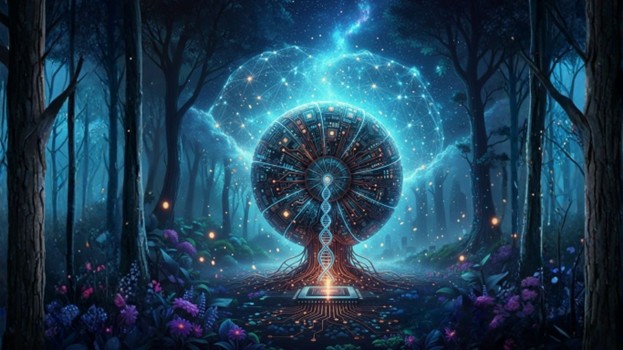
There’s a secret that nature has kept for billions of years, and we’re just beginning to decipher it. While our current computers operate in a linear, “mechanical” way, life itself seems to operate on a different plane. Exploring the potential of quantum computing isn’t just about building more powerful machines, it’s about bringing our data processing closer to the astonishing efficiency of the natural world.
Nature as the first Quantum Computer
Just as physicist Richard Feynman (Nobel Prize winner in physics and “spiritual father” of quantum computing) said:
“Nature is not classical, vivaddio, and if you want to make a simulation of nature, you’d better do it mechanical-quantum.”
Why draw a parallel with biology? Think of chlorophyll photosynthesis. When a plant captures light, it must transport the energy to the “reaction center” to turn it into nourishment. If it followed the rules of a classical computer (one bit at a time), the energy would be dispersed along the wrong paths.
Instead, nature exploits mechanisms similar to superposition: energy simultaneously “explores” all possible paths to instantly find the most efficient. This is exactly the heart of the potential of quantum computing: not to proceed by trial and error, but to be everywhere at the same time.
The potential of quantum computing: beyond the limits of traditional computers
The world of technology is experiencing a silent revolution that promises to fundamentally change the way we solve humanity‘s most complex problems. At the heart of this transformation is the potential of quantum computing, a technology that is not limited to being “faster“ than the current one, but works according to completely different physical rules. If a traditional computer can be compared to a librarian reading one book at a time to find a piece of information, a quantum computer is as if it could read all the books in the library at once.
What is a Qubit? The Basis of the Revolution
To understand the potential of quantum computing, we need to look at its fundamental building blocks: qubits. In the computers we use every day (smartphones or laptops), information is stored in “bits“, which can be as little as 0 or 1. It‘s like a light switch: it‘s either on or off. The qubit, on the other hand, exploits the laws of quantum mechanics to exist in a “superposition“ of states. It can be 0, 1 or both at the same time. This feature allows an immense amount of data to be processed in parallel, opening up previously unimaginable horizons.
How the ion trap works: manipulating atoms with light
While classical computers use circuit boards printed on silicon, the operation of the ion trap is based on individual atoms suspended in a vacuum. These atoms are “stripped“ of an electron, becoming ions (particles with an electric charge). Being charged, they can be captured and held in space thanks to electromagnetic fields, just as if they were suspended in an invisible vice.
How does a “trapped“ qubit work?
Imagine a row of transparent beads suspended in mid-air. Each bead is an atom. To write information about these beads, scientists use lasers.
Suspension: Electric fields create a sort of invisible “tube” where ions remain aligned.
Manipulation: A laser beam hits a single ion to change its state (from 0 to 1, or superimposed).
Entanglement: If we vibrate one ion, the vibration is transmitted to the others along the line, allowing them to “talk” to each other.
The harmony of data: entanglement
In an orchestra, if the first violin changes pace, all the others follow him to maintain harmony. In ion traps, the same happens: the vibrations of the qubits transmit information from one atom to another instantaneously. If we want two qubits to work together (entanglement), we make sure that their vibrations are “tuned“. This coordinated dance makes it possible to solve calculations that would take ordinary computers thousands of years, simply by letting the atomic melody develop towards the most efficient solution.
Qubit vibrations: the atomic music of quantum computing
If traditional computers are like Morse code (dot or line), the ion trap quantum computer is a symphony orchestra where the atoms are the notes. In a traditional musical note, the string vibrates at a specific frequency. In quantum computing, thanks to the vibrations of qubits, an atom can vibrate in multiple ways at once. It‘s as if a piano string could emit a “C“ and a “G“ at the same instant, creating a chord that contains much more information than a single note.
Imagining atoms as musical notes is not only a poetic way of describing science, but it is technically very close to reality. In the operation of the ion trap, the ions are not stationary and rigid; they float, linked together by an invisible “spring“ made of electrical repulsion. When we use a laser on one of them, it is as if we plucked a string: we generate vibrations of the qubits that propagate along the entire chain.
Pragma Etimos and extracting value from data
In this scenario of increasing complexity, companies like Pragma Etimos play a fundamental role. If quantum computing is the “engine“ of the future, semantic analysis and data organization are the refined fuel.
The potential of quantum computing applied to large volumes of data will allow us to overcome the current limits of textual and semantic analysis. Imagine being able to analyze billions of documents no longer by searching for keywords, but by instantly understanding every single nuance of meaning and hidden correlation, as naturally as an ecosystem reacts to external stimuli.
Towards a more natural intelligence
Thanks to the potential of quantum computing, we could move away from the rigidity of silicon to embrace a logic we call “fluid.” Quantum computers are no longer closed boxes that execute orders, but systems that mimic nature‘s ability to handle uncertainty.
Sostainability e Potential of Quantum Computing
Another point of contact with nature is energy efficiency. A traditional supercomputer consumes huge amounts of electricity to solve complex problems. Harnessing the full potential of quantum computing would mean being able to solve the same problems by consuming a fraction of the energy, just like the human brain which, despite being the most powerful “computer“ on the planet, runs on the power of a 20–watt light bulb.
A “Resonant” technology
Exploiting the vibrations of qubits would therefore mean stopping fighting against the complexity of nature and finally starting to resonate with it. We are moving from a computer science made of “on/off” switches to one made of resonances, harmonies and frequencies.
Pragma Etmos’ commitment to bringing order to informational chaos would find the perfect ally in quantum computing: a synergy between human accuracy (the etymology, the true meaning of things) and the computing power of universal physics.
POTREBBE INTERESSARTI ANCHE…
ATHENA: TRASFORMARE I DATI IN INFORMAZIONI DI VALORE
Risk Management: come gestire i dati
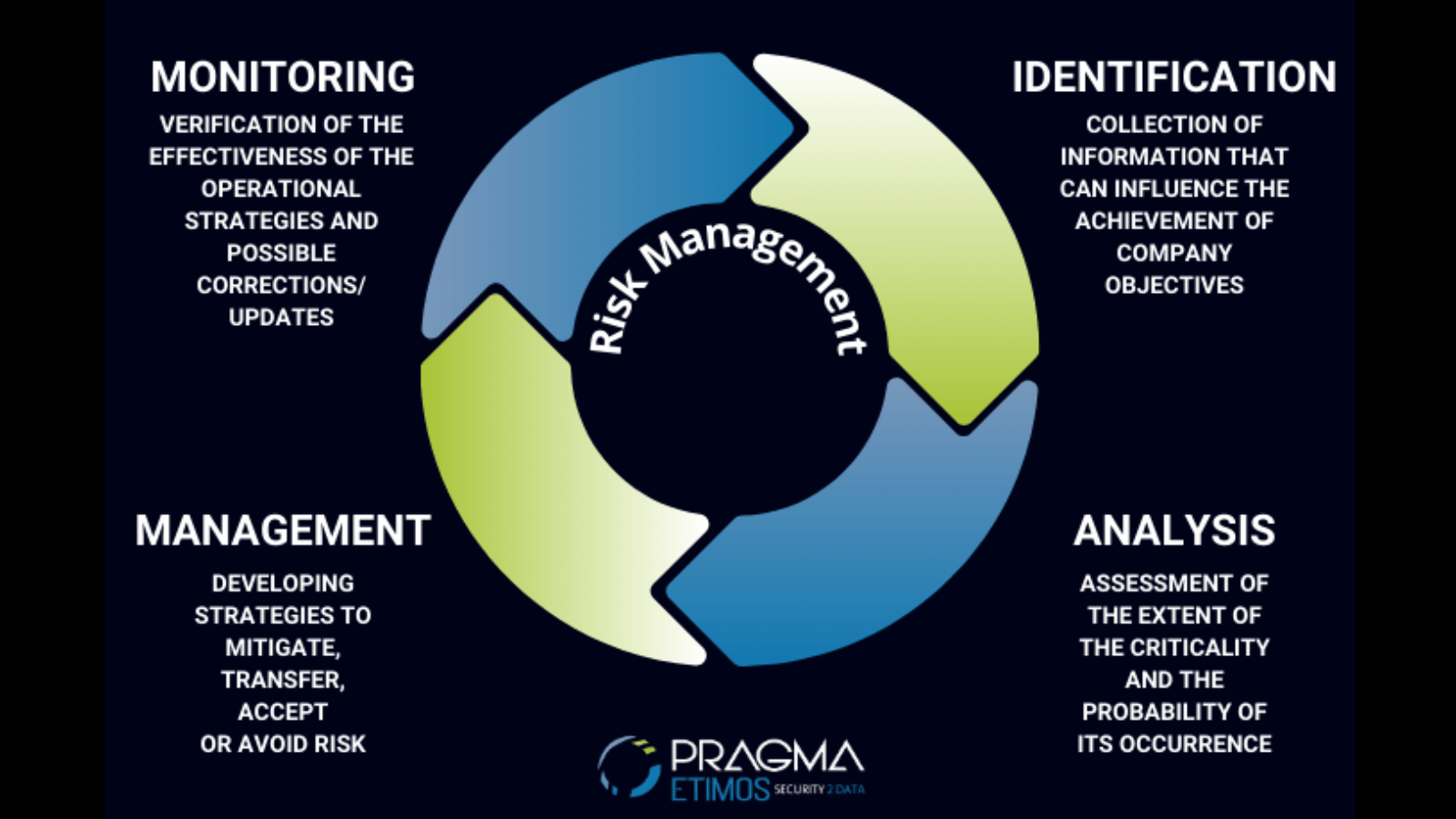
Sviluppare un piano di Risk Management è un’attività particolarmente complessa, che deve tener conto di una lunga lista di fattori anche distanti tra loro: dagli aspetti legali ai conti finanziari, passando per il settore pubblicitario, le relazioni con…