
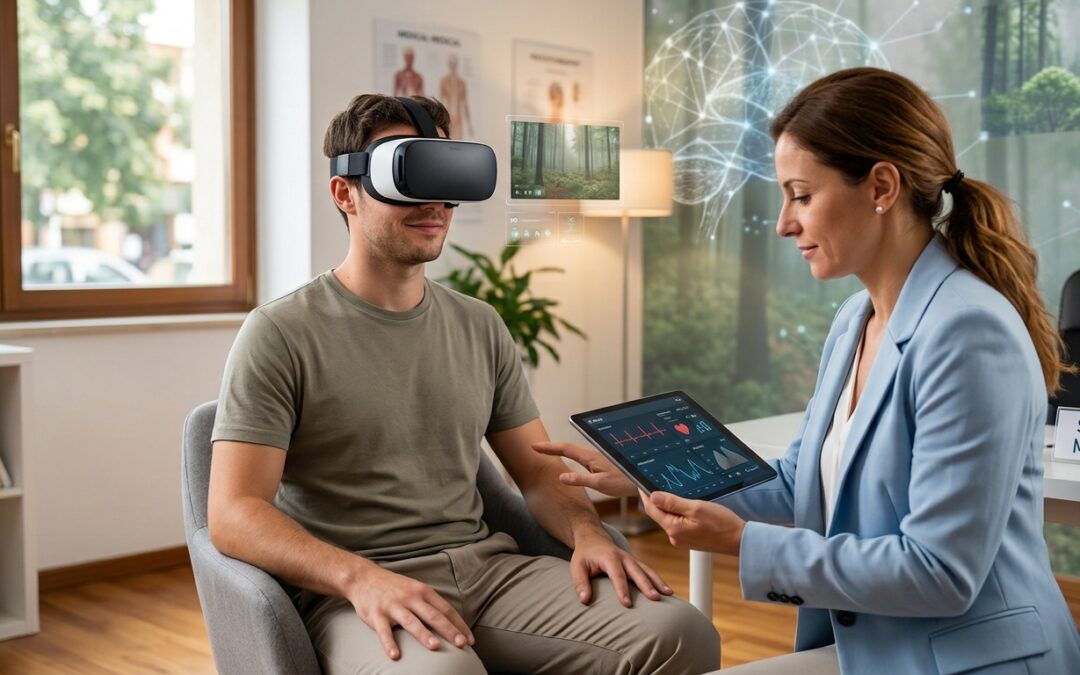
When we think of 3D headsets and digital worlds, our minds immediately jump to video games, immersive cinema, or youth entertainment. However, far from gaming consoles, one of the most revolutionary and human applications of modern technology is taking shape: the use of virtual reality for mental health as a doctor-guided therapeutic tool.
Far from being a form of isolation, immersive technology is becoming a true window of healing for those suffering from anxiety disorders, phobias, post-traumatic stress, and panic attacks.
What it is and how virtual reality for mental health works
To understand how this therapy works, we must look at how our brain reacts to fear. If we are terrified of public speaking or boarding an airplane, our body triggers very real physical responses: accelerated heart rate, sweating, and a feeling of suffocation.
With the help of virtual reality in mental health care, a psychotherapist can place the patient inside a controlled and safe digital environment. Through the headset:
- A person with a phobia of flying can simulate being on an airplane while sitting comfortably in the doctor’s office.
- Anyone suffering from social anxiety can practice speaking in front of a 3D virtual audience.
- Biosensors measure the patient’s heart rate and breathing in real time, providing the doctor with objective emotional data.
Virtual reality allows patients to face what scares them step by step, within a protected setting where they know they can stop the experience at any moment.
Gradual exposure and relaxation through immersive technology
The fundamental principle behind this method is called “gradual exposure therapy.” By repeatedly facing a frightening situation inside the digital world without any real danger, the brain “learns” to downsize the threat, reducing anxiety in real life.
However, it is not just about overcoming phobias. Virtual reality is also successfully used in meditation and relaxation practices. Immersing oneself in a pristine digital forest or walking on a beach at sunset, guided by breathing exercises, helps cancer patients or people dealing with chronic pain reduce stress and regain peace of mind.
A complementary support to the human touch
It is essential to emphasize that the VR headset does not replace the psychologist or psychiatrist in any way. Technology remains a simple bridge—a tool in the hands of the therapist who guides the session, interprets emotional reactions, and helps the patient process the experience lived in the virtual world.
A more accessible future for psychological care
Making these technologies more accessible and easier to use will allow an increasing number of medical centers and hospitals to adopt them. The widespread adoption of virtual reality in therapy demonstrates how innovation, when guided by empathy and science, can become an extraordinary resource to protect and nurture our most intimate well-being.
MORE TO EXPLORE…

Natural Language Processing: Tasks, Applications and Sentiment Analysis
The human-machine dialogue has been one of the most active areas of research for decades. In recent years, great progress has been made in the field of NLP (Natural Language Processing), although, due to the complexity of human language, the machine is not yet able to understand perfectly… Read more
Chatgpt: a positive revolution if managed correctly
For a few months now, Artificial Intelligence has been making an explosive statement, generating a lot of interest accompanied by doubts, controversies and perplexities.
The wide diffusion of ChatGPT has raised a heated discussion among experts who have focused on understanding the real innovative scope of this intelligent tool. However, the Italian Data Protection Authority has intervened by blocking the use of the data as it does not comply with all the criteria set out in the Data Protection Act…