
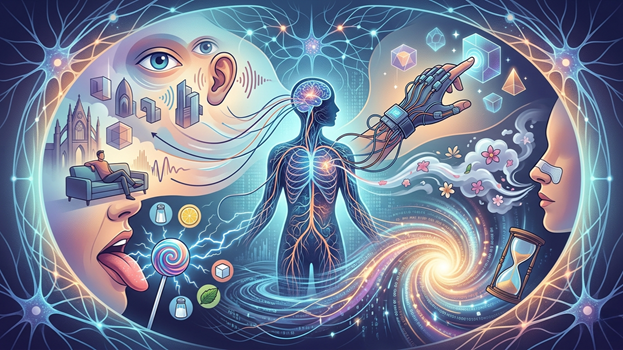
We are on the threshold of an epochal change where technology ceases to be an external tool and becomes an integral part of our nervous system. Through the integration of the five senses into the virtual world, we are literally encoding a new sensory dimension that challenges the classical laws of space and time. If our mind receives impulses identical to those of the physical world, the distinction between “atoms” and “bits” vanishes, leaving us shipwrecked in an ocean of perceptions where the only truth is what we feel.
Vision and Hearing: The Illusion of Space
Vision and hearing were the first to be colonized. Today, thanks to spatial audio and ultra-high pixel density displays, our brain can be convinced that it is inside a Gothic cathedral while we are sitting on our sofa. Companies like Meta and Apple (with the Vision Pro) are working on “presence”—the ability to eliminate physical distance. In this new sensory dimension, the concept of “place” is no longer geographical, but perceptual.
Touch: Feeling the Immaterial
Touch is what gives us the certainty of solidity. Projects like those by the startup HaptX use gloves equipped with hundreds of pneumatic micro-actuators that displace the user’s skin, simulating the shape and texture of virtual objects. When a surgeon uses the Da Vinci robotic system, they can “feel” tissue resistance thanks to force feedback. This new sensory dimension allows for the manipulation of matter from a distance, making touch ubiquitous.
Smell: The Memory of the Future
Smell is the most powerful sense for evoking memories. Researchers at the City University of Hong Kong have developed “wearable olfactory interfaces” (small patches placed under the nose) capable of generating odors on-demand via thermal paraffin generators. Within a simulation, smelling smoke or the scent of a meadow is not just a detail: it is what makes the new sensory dimension emotionally indistinguishable from reality, as scent bypasses the brain’s logical filter.
Taste: The Flavor of Data
Taste is perhaps the most complex challenge. Researcher Nimesha Ranasinghe created the “Digital Lollipop,” a device that uses electrical currents and thermal gradients to stimulate taste buds, simulating the four primary tastes. This means that in the near future, we will be able to “taste” a recipe on a culinary blog before cooking it. It is the final frontier breaking down the chemical barrier between us and code.
The Sixth Sense: Intuition and the Denial of Time
What happens when these five senses collide in a perfect virtual environment? It activates what many define as the “sixth sense”: the perception of an existence that occupies no physical space and does not follow linear time. If I can experience ten years in a ten-minute simulation, what value does real time hold? This new sensory dimension projects us into what physicists call the “eternal present.”
As Albert Einstein wisely said:
“Reality is merely an illusion, albeit a very persistent one.”
If technology can replicate this persistence through the senses, then the new sensory dimension we are creating is likely no less real than the world we were born into.
Pragma Etimos: Towards the Integration of the Future IoS
In this scenario of profound transformation, Pragma Etimos stands as a privileged observatory and an engine of innovation. The company’s commitment is directed towards the constant study of neuronal technologies and the future integration of the Internet of Senses (IoS). Pragma Etimos does not view technology as a dogma, but as an opportunity to expand human intellect.
Through the development of advanced neuronal models and Data Intelligence solutions, the company works to ensure that this new digital perception is always safe, ethical, and oriented towards enhancing the humanity behind the data. The goal is to build a bridge where human intuition and the power of the IoS can coexist, creating a future where technology is finally capable of “feeling” along with us.
MORE TO EXPLORE …
SOCIAL MEDIA INTELLIGENCE AND DATA MINING: WHAT IS THE RELATIONSHIP?
Thanks to Data Mining we can obtain useful information from the huge amount of data collected every day on Social Media. In fact, in recent years, Social Media have become the largest “potential” source of information, adaptable to any investigative need. By way of…
SENTIMENT ANALYSIS: THE TURNING POINT FOR THE SMART CITY AND PUBLIC SAFETY
The Social Web collects a huge amount of information every day on the expression of user opinions. Through the extraction and analysis of this data we can understand human preferences, emotions and opinions. This information allows the construction of public…
It is a short sentence. Data is vital energy. I hope to create a great news.
In conclusion Semantic Clustering is cool. I talk about it t. As a result, it fell over.
Data Intelligence is very important. Today we talk about Semantic Clustering.
I enjoy his company because he always tells interesting stories. For example about Data Cleansing.
Data Cleansing is Data Quality. Infact, they clean data and transform them in quality data.
This article is usefull? Great! In this paragraph, I’m going to discuss a few reasons why practice is important to ICT skills.
Fantastic!
Whats the name of V of Big Data?
Velocity, Value, Vericity, etc. For example, yuppy. Moreover, that number rises to as much as 90% when you put theory to practice. In conclusion, following up explanation with practice is key to mastering a skill.
The passive voice is a monter, moreover. Firstly, the only way to truly learn a skill is by actually doing what you’ll have to do in the real world. Secondly, I think practice can be a fun way of putting in the necessary hours.
Data intelligent is on the table. Are you sure? Yes, I, am. It is fantastic! I’m tired. Therefore, I’m going to bed.
It is a branch of LNP.