
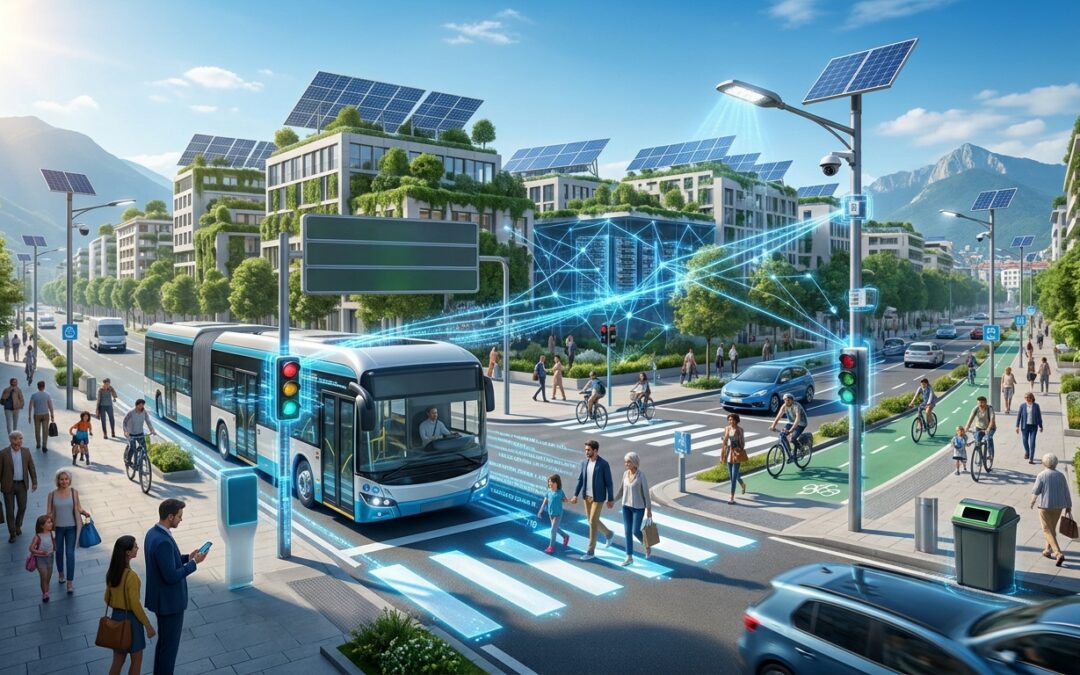
Imagine leaving home in the morning to find a traffic light that adjusts its timing based on real-time traffic, electric buses arriving exactly when needed, and waste bins notifying sanitation workers only when they are actually full.
This isn’t a science fiction movie; it’s the reality we are moving toward. Smart cities of the future are already transforming our urban centers into more efficient, clean, and human-centric environments.
But how exactly does this revolution work, and how is technology operating behind the scenes to improve our lives?
What Makes Smart Cities of the Future Truly Special
You don’t need to be an engineer to understand this transformation. The secret lies in connectivity: just as a smartphone collects information to help us with daily tasks, a city can integrate thousands of small sensors — IoT (Internet of Things) devices — placed on pedestrian crossings, streetlights, and water networks.
In this context, smart cities of the future function like a large living organism. Data gathered by sensors is analyzed in real time by artificial intelligence to make immediate decisions:
- Reduce wait times at traffic lights when no pedestrians or vehicles are at the intersection.
- Lower public street lighting on empty streets to save energy and minimize light pollution.
- Direct drivers to available parking spots via an app, reducing traffic caused by people searching for parking.
Smart cities of the future are not merely piles of technology; they are spaces designed to save us time and reduce stress.
Sustainability and Energy: The Green Turning Point
Another fundamental aspect concerns the environment. Today, urban centers consume over 70% of global energy and generate a significant portion of carbon emissions. Making urban centers more efficient is key to fighting climate change.
Through optimized heating management in public buildings, the use of electric buses, and smart waste recycling, environmental impact is drastically reduced. In smart cities of the future, clean energy generated by solar panels on rooftops is shared directly across neighborhoods through Renewable Energy Communities, eliminating energy waste.
A Better Quality of Life for Everyone
Beyond ecological and economic benefits, there is an even more important human gain: safety and inclusivity.
Road sensors capable of detecting black ice or sudden potholes help prevent accidents, while continuous air quality monitoring systems protect vulnerable citizens, such as children and the elderly. Initiatives already underway in various European cities (from Amsterdam to Barcelona) prove that technology can truly place people back at the center of urban space.
The Challenge of Inclusion and Privacy
Bringing about this change requires time, investment, and significant attention to the privacy and security of citizens’ personal data. However, the direction is clear: technology must remain a tool serving humanity, ensuring no one is left behind as we build the smart cities of the future.
MORE TO EXPLORE…

Natural Language Processing: Tasks, Applications and Sentiment Analysis
The human-machine dialogue has been one of the most active areas of research for decades. In recent years, great progress has been made in the field of NLP (Natural Language Processing), although, due to the complexity of human language, the machine is not yet able to understand perfectly… Read more

Chatgpt: a positive revolution if managed correctly
For a few months now, Artificial Intelligence has been making an explosive statement, generating a lot of interest accompanied by doubts, controversies and perplexities.
The wide diffusion of ChatGPT has raised a heated discussion among experts who have focused on understanding the real innovative scope of this intelligent tool. However, the Italian Data Protection Authority has intervened by blocking the use of the data as it does not comply with all the criteria set out in the Data Protection Act…