
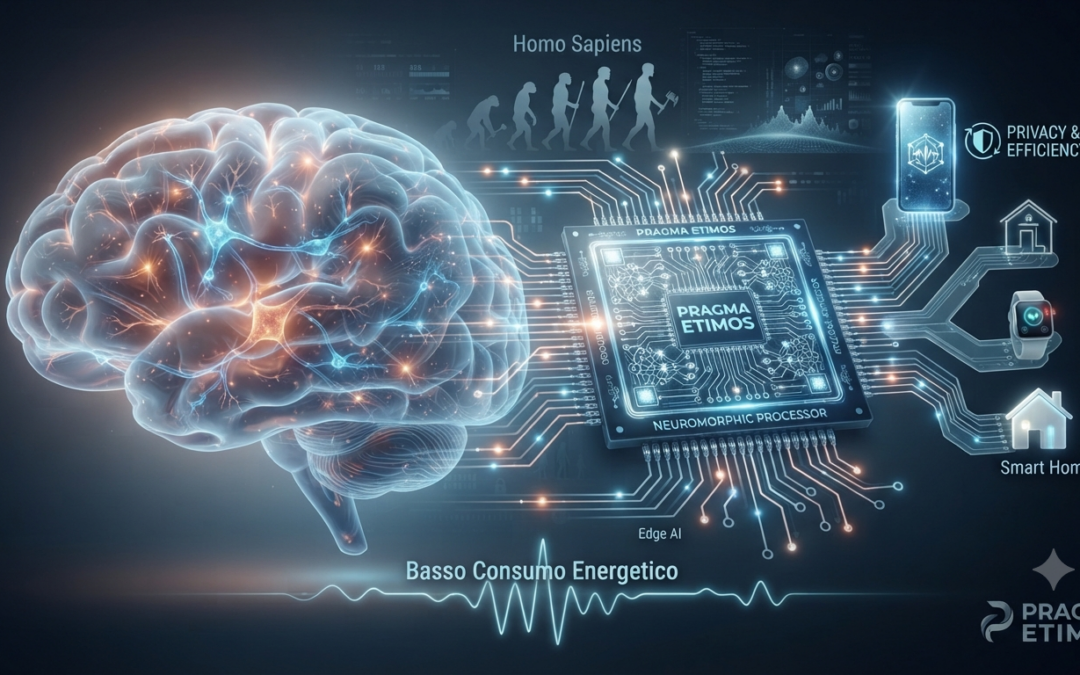
“We are not here to create a copy of man, but to understand the architecture of the mind and mirror it in matter.” — Alan Turing (philosophical adaptation on computational thought)
Imagine if your computer, instead of processing billions of data points while consuming the energy of an entire household appliance, could operate using the same power as a pocket flashlight and “reason” like a biological brain.
This scenario no longer belongs to science fiction, but to the concrete reality toward which neuromorphic technology chips are guiding us. This is a new generation of processors designed not to surpass human intelligence in brute force, but to copy its fundamental structure: neurons and synapses. Until now, computing has followed a rigid line (memory on one side, processor on the other), forcing data into a continuous and wasteful back-and-forth journey. In contrast, neuromorphic systems eliminate this distance, uniting storage and processing into a single interconnected network.
From caves to silicon: the parallel between anthropological evolution and cybernetic evolution
To truly understand the scope of this transition, it is fascinating to trace a parallel between man’s biological evolution and that of computers. In anthropological history, Homo Sapiens conquered the world thanks to the plasticity of its brain: the ability to adapt to environmental changes instantaneously, modifying its own neural connections without the need for a “hardware upgrade.”
Cybernetic evolution is following a surprisingly similar trajectory. We have moved from the large centralized computers of the 1960s (the “dinosaurs” of technology, massive and rigid) to increasingly streamlined machines, leading today to neuromorphic technology chips. This metamorphosis represents the shift from the era of fixed and immutable algorithms to the era of plastic and evolutionary learning. Just as human evolution rewarded the energy efficiency of the brain (which weighs very little yet governs the entire organism), cybernetic architecture is abandoning colossal data centers to miniaturize intelligence directly inside individual devices.
Pragma Etimos’ commitment to the frontier of data and innovation
In this landscape where the boundaries between biology and digital are increasingly blurred, the ability to manage the complexity of information becomes the true differentiating factor for the market. We at Pragma Etimos have always been at the forefront of technological evolution, translating complex data flows into strategic and concrete solutions for businesses. For us, looking to the future means understanding the impact of revolutionary architectures such as neuromorphic technology chips, integrating scientific vision with operational effectiveness. Our goal remains to lead innovation, ensuring that digital evolution is not only high-performing, but also sustainable and accessible.
Why neuromorphic technology chips will change our everyday devices
The true revolution of this technology will be reflected in our daily lives. Currently, when a smartphone needs to recognize our voice or process an image in real time, it sends the data to a remote server (the Cloud). This process requires an internet connection, time, and an immense global expenditure of energy.
The inclusion of a neuromorphic technology chip directly inside phones, automobiles, or home automation assistants will allow these objects to “think” and evolve on the fly, in total autonomy (Edge AI). Your device will not simply execute preset commands, but will learn from your daily habits in real time, without sending your personal data externally and thus guaranteeing extraordinarily high privacy standards.
Sustainability and the future with neuromorphic technology chips
Beyond convenience and security, there is a fundamental ethical and ecological reason why the industry is accelerating in this direction: the environmental impact of traditional artificial intelligence has become unsustainable. The large-scale adoption of neuromorphic technology chips promises to drastically cut the carbon footprint of the tech sector.
From immediate medical diagnostics via wearable devices that monitor health by signaling anomalies before they occur, to the management of city electrical grids, these biological processors will open the doors to an era where technology is finally integrated, intelligent, and, above all, in harmony with the planet’s resources.
MORE TO EXPLORE…

Natural Language Processing: Tasks, Applications and Sentiment Analysis
The human-machine dialogue has been one of the most active areas of research for decades. In recent years, great progress has been made in the field of NLP (Natural Language Processing), although, due to the complexity of human language, the machine is not yet able to understand perfectly… Read more
Chatgpt: a positive revolution if managed correctly
For a few months now, Artificial Intelligence has been making an explosive statement, generating a lot of interest accompanied by doubts, controversies and perplexities.
The wide diffusion of ChatGPT has raised a heated discussion among experts who have focused on understanding the real innovative scope of this intelligent tool. However, the Italian Data Protection Authority has intervened by blocking the use of the data as it does not comply with all the criteria set out in the Data Protection Act…