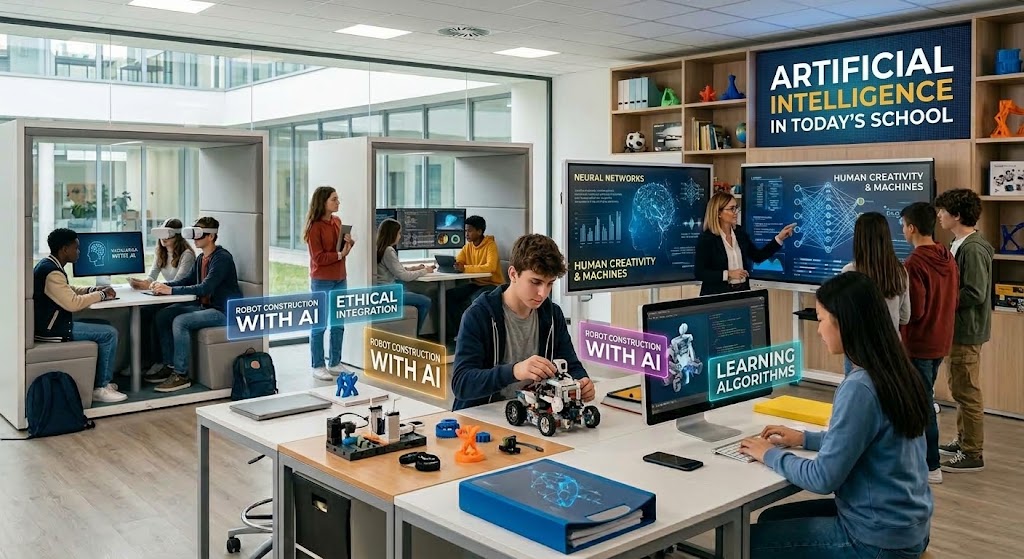
The arrival of new digital tools in classrooms is radically transforming traditional teaching. Understanding how to integrate artificial intelligence in today’s schools is not simply about bringing new technologies to the desks, but about preparing students to live and work in a rapidly evolving world, without ever sacrificing critical thinking and independent judgment.
Students and teachers are facing daily shifts of historic proportions. Adopting generative software and advanced algorithms in education is not just about using advanced platforms to complete homework or summarize texts; it involves a true redefinition of the very concept of learning, teaching, and assessment.
The Benefits of Artificial Intelligence in Learning
One of the main advantages offered by this technological revolution is the personalization of study. Intelligent tutoring platforms can adapt explanations, learning paces, and educational materials to the specific needs of each student. Algorithms can identify learning gaps in real time and offer targeted exercises to overcome them, ensuring inclusive support even for students with Special Educational Needs (SEN) or learning disabilities.
On the other hand, teachers can benefit greatly from the automation of bureaucratic and repetitive tasks, such as grading standardized tests, managing attendance records, or searching for basic resources. Freed from these routine duties, educators can devote more time and energy to the human factor: empathetic relationships, active listening, pedagogical mediation, and Socratic teaching.
Ethical Challenges, Skills, and the Future of Education
Teaching students how to use these tools mindfully requires establishing clear, shared guidelines. It is not about giving in to prohibition or banning technology from the classroom—an approach that would prove outdated and ineffective—but about teaching its ethical, critical, and responsible use.
Promoting digital literacy makes it possible to guide the integration of artificial intelligence in today’s schools toward an integrated educational model. In this vision, technology becomes an amplifier of human cognitive potential—an assistant that supports the mind without ever replacing analytical capacity, critical thinking, or personal creativity. The true educational challenge of the future lies in teaching students not only how to ask the right questions to AI, but how to verify sources and critically evaluate the answers they receive.
MORE TO EXPLORE…

Natural Language Processing: Tasks, Applications and Sentiment Analysis
The human-machine dialogue has been one of the most active areas of research for decades. In recent years, great progress has been made in the field of NLP (Natural Language Processing), although, due to the complexity of human language, the machine is not yet able to understand perfectly… Read more
Chatgpt: a positive revolution if managed correctly
For a few months now, Artificial Intelligence has been making an explosive statement, generating a lot of interest accompanied by doubts, controversies and perplexities.
The wide diffusion of ChatGPT has raised a heated discussion among experts who have focused on understanding the real innovative scope of this intelligent tool. However, the Italian Data Protection Authority has intervened by blocking the use of the data as it does not comply with all the criteria set out in the Data Protection Act…